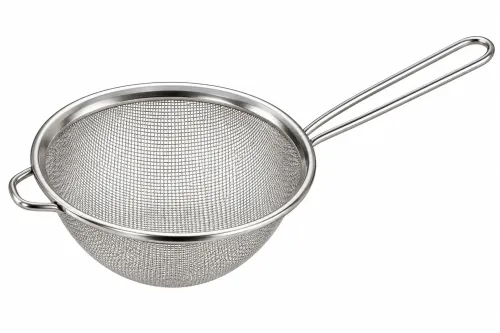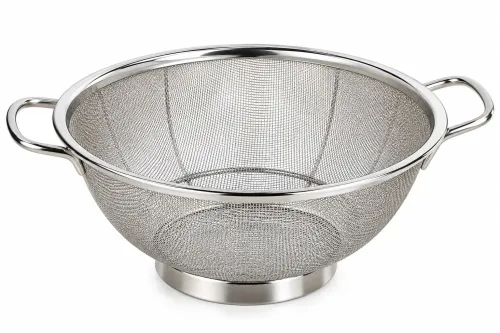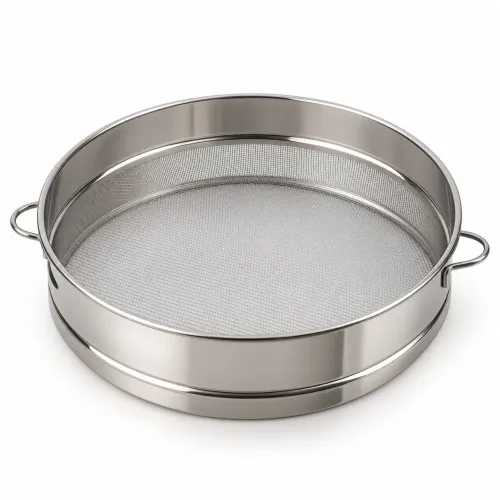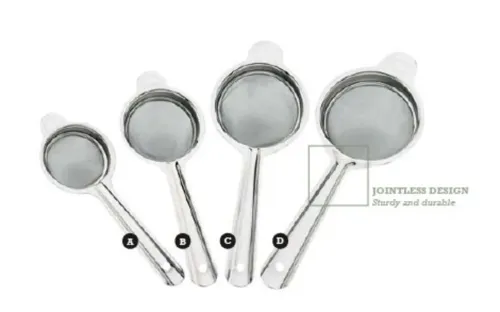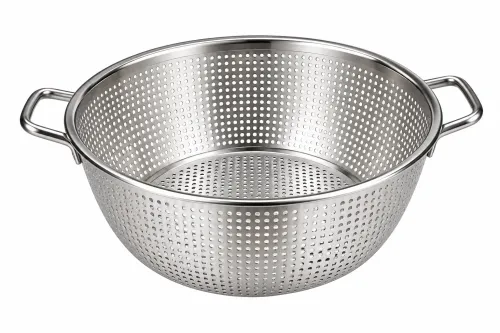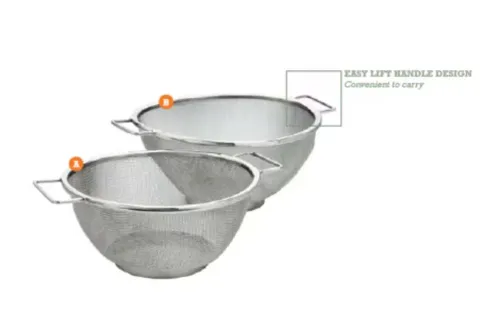
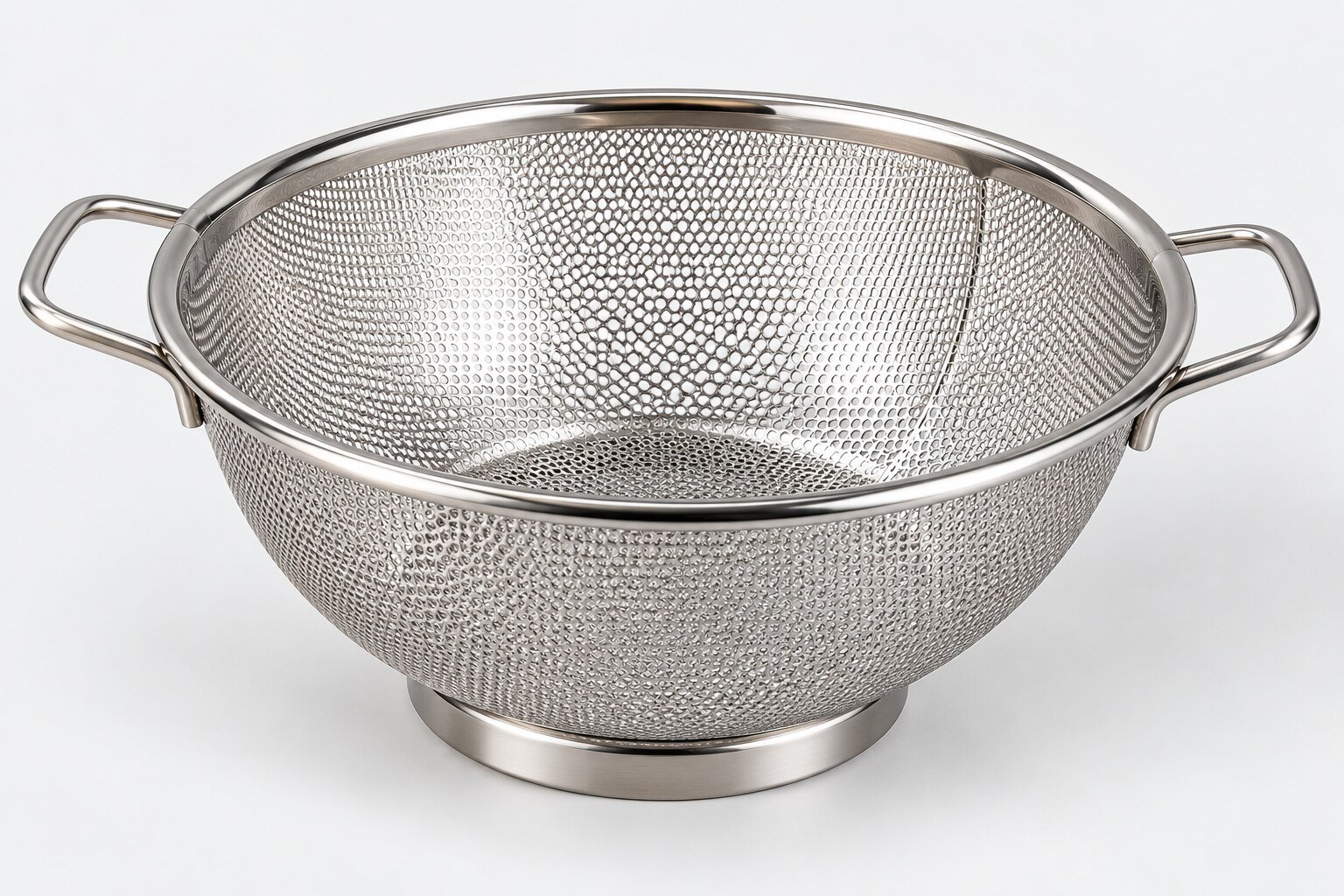
A basket that drains quickly can still lose berries, rice or chopped vegetables through openings that are too large, while a fine mesh can clog with skins, starch and pulp. By comparing aperture data, construction, geometry, handles, materials and load tests, you can judge whether a basket will wash food efficiently and remain safe and stable in your sink or over a pot.
Key takeaways
- Match mesh openings to the smallest food pieces you need to retain.
- Choose welded or securely joined mesh with no soil-trapping crevices.
- Check feet, handles and bowl shape under a full wet load.
- Request material, finish, dimensions and load-test details before ordering.
How opening size controls washing, retention and drainage
A mesh colander strainer basket must pass soil and rinse water while retaining the smallest food pieces being washed. Manufacturers therefore select mesh opening size against the food, not against a nominal mesh count alone.
| Food | Retention priority | Design trade-off |
|---|---|---|
| Leafy greens | Retain torn leaves while passing soil and water | Coarser openings improve rinsing and reduce debris blockage |
| Berries | Retain small fruit and prevent bruising | Moderate openings limit loss while allowing rapid drainage |
| Rice | Retain individual grains | Smaller openings increase retention but slow flow |
| Pasta | Retain short pieces and broken strands | Openings need to balance drainage with fragment retention |
| Legumes | Retain small lentils, peas or beans | Aperture depends on the smallest item in the batch |
| Cut vegetables | Retain small cubes and slices | Openings must suit the smallest cut, not the average piece |
Clear aperture is the actual open distance between adjacent wires; wire diameter is the thickness of those wires. In square woven mesh, approximate open area is [a/(a+d)]² × 100, where a is clear aperture and d is wire diameter.
Two baskets with the same mesh count can drain differently because different wire diameters produce different apertures and open areas.
Finer mesh creates greater hydraulic resistance and blinds faster when flour, starch, skins, pulp or surface debris cover the openings. Specify a retention range, aperture tolerance and aperture measurements from several basket locations; do not accept an unqualified mesh number. Woven mesh varies locally, so one measurement can hide a slow-draining section.
Which basket construction gives the best balance of flow and cleanability
Perforated stainless sheet usually gives the best balance of drainage and cleanability for a general food-washing basket. Its rigid bowl and smooth internal surface resist dents, while larger round or formed holes often need more open area to match the drainage rate of woven wire mesh.
| Construction | Strength | Cleaning and drainage trade-off |
|---|---|---|
| woven wire mesh | Retains small particles and allows flexible open-area design | Overlaps can catch food; exposed wires are vulnerable to snagging, denting and edge distortion |
| perforated sheet | Forms a stiff bowl with smooth, continuously accessible surfaces | Larger holes may be needed to equal mesh flow; poorly formed joints still create crevices |
| expanded metal | Stiff, continuous construction with directional openings | Raised strands can trap food, while sharp edges and deep corners complicate cleaning |
Choose woven wire mesh when retention of rice fragments, seeds or other small pieces matters more than rapid washing and easy wiping. Check every overlap and termination: distorted edges and trapped food turn a fine basket into a hygiene problem.
Choose expanded metal only when the strands are fully rounded and the bowl is formed without inaccessible corners. Poor finishing leaves sharp edges and enclosed channels that retain wet food or detergent and slow drying.
A one-piece formed bowl is easier to clean than several overlapping panels. Use rounded internal corners, accessible panel joints and a closed rolled or formed rim; these features prevent burrs and food traps while adding stiffness. A smooth continuous surface also makes visual inspection straightforward.
How bowl shape, feet and handles determine stability in use
Colander basket geometry determines whether a full basket sits steady, drains freely, and lifts without spilling; mesh is only one part. A deeper bowl holds more but raises the centre of gravity, while a steep sidewall angle preserves capacity and a shallow angle spreads food for faster drainage.
A wider base reduces load concentration and improves drainage area, but must fit the sink or receiving vessel.
Feet or a support ring keep the working mesh above a sink or bowl, so water does not pool underneath. They need enough stiffness to resist splaying; otherwise the basket rocks, concentrates force at a few welds, and can scratch the support surface.
A rolled rim adds stiffness, shields cut wire ends, and creates a repeatable bearing surface. Inspect closed rim terminations for burrs, gaps, and food traps.
A full wet load exposes weak handle design. Check these points before ordering:
- Flat handles offer broad hand contact; wire handles use less material but can press into the hand; tubular handles feel more comfortable but transmit heat along the metal.
- Demand broad attachments, folded mounting tabs, or continuous welds rather than two small spot welds.
- Confirm grip clearance from the bowl, especially when lifting over a pot.
- Test a loaded basket for tipping, handle flex, and weld movement.
Nesting depends on rim bead height, handle orientation, foot placement, and mesh deformation—not nominal bowl diameter alone. Request nested height and packed dimensions; feet or distorted rims can make identical-size baskets bind.
What material, finish and food-contact details should you compare
Do not accept “stainless steel” as a specification: ask for the stated grade and finish. 304 stainless steel is the common general-purpose choice for kitchen baskets. 316 stainless steel resists chloride exposure better, but salt, bleach and aggressive dishwasher chemistry can still cause pitting.
| Material | Strength and risk | Inspect or request |
|---|---|---|
| 304 stainless steel | Good general corrosion resistance | Grade certificate and surface finish |
| 316 stainless steel | Greater chloride resistance, not immunity | Chloride and dishwasher-use limits |
| Mild steel | Rusts when paint, plating or passivation is absent | Coating damage at rims, welds and contact points |
| Tin-plated or galvanised steel | Coating protects the base metal until worn or breached | Peeling, exposed steel and coating wear at rims, welds and feet |
Welded assemblies need clean welds and, where specified, weld cleaning followed by passivation. Electropolishing can reduce surface contamination and improve cleanability, but it will not repair crevices, remove a badly ground burr or stop chloride deposits from attacking the metal.
Food-contact compliance covers the complete assembly, not just its basket wire. Confirm the status of grips, feet, coatings, lubricants, solder and labels under EU Regulation (EC) No 1935/2004 and manufacturing controls under Regulation (EC) No 2023/2006.
Ask for the stated dishwasher condition or test protocol: high-pH detergents, trapped food, chlorides and dissimilar-metal contact can cause staining, pitting or galvanic attack, while polymer grips and bonded labels can loosen.
How to test fit, load capacity and manufacturing quality before ordering
A catalogue diameter proves little if the rim hits the sink, the handle strikes the cabinet, or the basket cannot lift a wet load safely. Test a production sample in the actual kitchen before approving a bulk order.
1. Record sink width and depth, pot diameter, cabinet clearance above the sink, handle projection, and the basket’s packed dimensions. Measure nested height with the handles, feet and rim beads fully engaged, not removed.
2. Fill the basket with the heaviest intended food load, add retained water, and weigh it. Record the basket load capacity with the mass, support condition and allowable permanent deflection stated; “holds 5 kg” is incomplete without those conditions.
3. Lift, shake and drain the loaded basket. Overloading slows drainage, presses food against the mesh or base ring, makes lifting difficult, bends the basket permanently, splays the feet and causes rocking that concentrates stress at welds.
4. Inspect the sample by touch for burrs, then turn it over for weld inspection. Examine rim, handle and foot weld undersides for projections, incomplete fusion and excessive heat tint; test each handle and foot attachment for movement after repeated loaded lifts.
5. Ask Unistar Kitchen Strainers or any export manufacturer for aperture records, material grade, finish details, load conditions, dishwasher test protocol and carton nesting data. Dishwasher suitability depends on detergent, chlorides, trapped food, dissimilar metals, polymer grips and labels—not a “dishwasher safe” claim alone.
Thicker wire, reinforcing rims, radial supports, formed bases and smaller unsupported mesh spans improve strength, but add weight, cost or cleaning geometry. Reject samples that rock, bind during nesting or exceed the stated permanent deflection after testing.
Related product
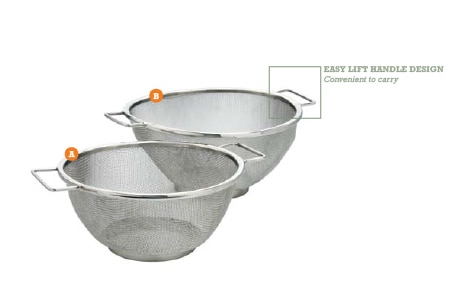 | Wire Mesh Colander / Fruit Basket Wire Mesh Colander / Fruit Basket We are known as a one of the leading Wire mesh strainer factories and Wire mesh Products manufacturers in India. View product → |
Frequently asked questions
How does mesh opening size affect washing and draining?
Larger openings drain faster and rinse more easily, but they can release small food pieces. Choose an opening smaller than the smallest item you need to retain, then confirm that it still passes soil and rinse water.
Which basket construction is easiest to clean?
A smooth, rigid basket with continuous welds and no exposed wire ends is easier to clean than a loosely joined mesh basket. Inspect the rim, handle joints and base for crevices that can trap food.
What makes a mesh colander stable during use?
A wide base, evenly spaced feet and handles positioned near the basket’s centre of gravity reduce tipping. Test stability with the basket wet and loaded, not only when it is empty.
What should you compare in food-contact basket materials?
Compare the specified metal grade, surface finish, weld quality, corrosion resistance and cleaning instructions. Ask for material documentation and inspect the surface for burrs, flaking, rust or exposed coating.
How can you test a strainer basket before placing a bulk order?
Measure the basket against your sink, pan or filling line, check the opening dimensions, load it with the intended food and water, and verify drainage, balance, handle strength and cleanability.